




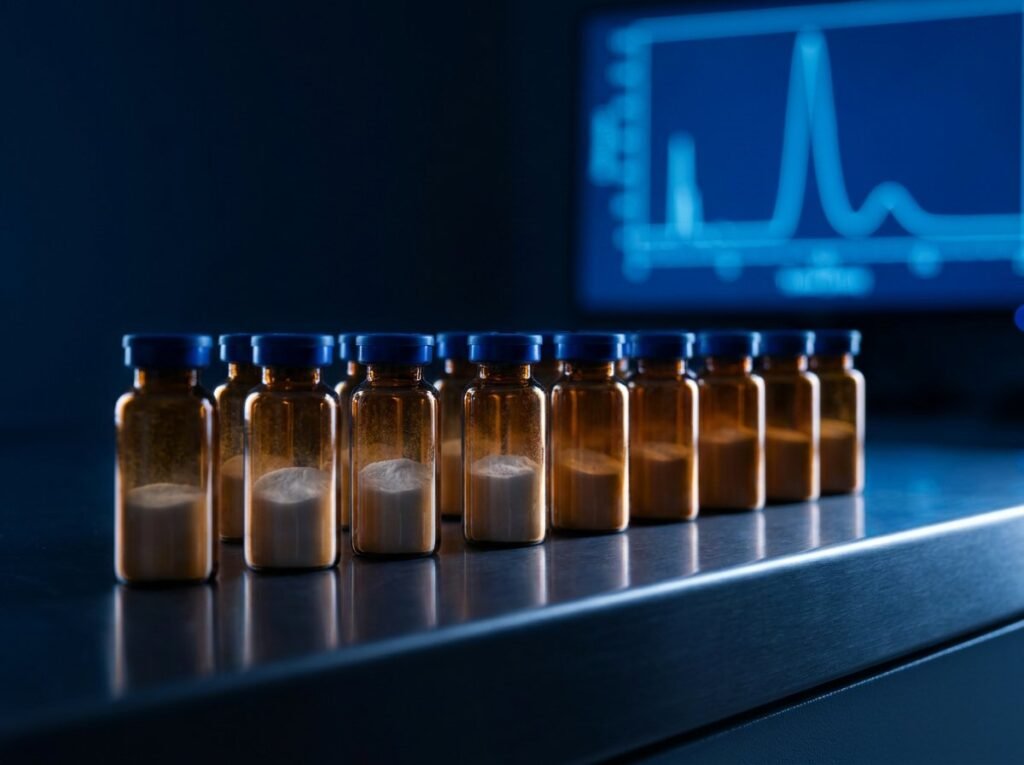
Procurement guide
Every vial we ship is a research reagent, sold for in-vitro laboratory and analytical use only. Nothing on this site is a drug, a supplement, or a product for human or veterinary administration. What follows is the reference material we would want to read before placing an order with any supplier, including us: what the analytical numbers on a certificate of analysis actually establish, what they cannot establish, how to compare two suppliers who both claim ninety-nine percent, and how to plan a reconstitution before the package arrives.
A research peptide supplier is worth ordering from when four things are true at once: the material is documented per lot rather than per product, the certificate of analysis names the analytical method and the laboratory that ran it, the purity figure is accompanied by an identity confirmation rather than standing alone, and the language on the site keeps the material inside a research-use-only boundary instead of drifting toward implied human use. A supplier that satisfies three of those four is not a bargain. The missing one is usually the one that matters.
Everything below expands on that. If you are in a hurry: our vials are tested by an independent third-party laboratory, the certificate of analysis is tied to the lot number printed on the vial, purity is reported at ninety-nine percent or higher by reversed-phase HPLC with identity confirmed by mass spectrometry, orders leave our facility within twenty-four hours, and shipping is free above one hundred and fifty dollars. You can browse the full catalog, read the lab testing documentation, or work out a dilution with the peptide reconstitution calculator before you commit to a vial size.
Research use only is not a disclaimer bolted onto a product page to manage legal risk. It is a description of what the material has been manufactured, tested and documented for. A reagent produced for in-vitro laboratory work is assessed against a different set of questions than a pharmaceutical product: purity and identity are characterized, but sterility, endotoxin load, pyrogenicity, excipient safety, stability under physiological conditions and dose-response behavior in a living system are not part of the release specification.
That gap is the whole point. A certificate of analysis reporting 99.4 percent purity by HPLC tells you something precise and useful about the contents of the vial. It tells you nothing whatsoever about whether that material would be safe or appropriate in a living organism, because the tests that would answer that question were never run. Treating an RUO purity figure as a safety clearance is the single most common category error in this market, and it is an error about what was measured, not about how carefully it was measured.
Practically, this shapes how a laboratory should read every page on a supplier's site. Specifications, tables and analytical data belong in the buying decision. Any language that implies a physiological outcome, a therapeutic application, a protocol for administration, or a comparison to an approved medicine does not, and its presence on a supplier's site is a signal about that supplier rather than about the compound. We hold ourselves to the same standard: you will not find dosing guidance, administration instructions or outcome claims anywhere on this site, including in the calculator, where volumes are described as aliquoting arithmetic for bench work rather than as doses.
Our catalog is organized by mechanistic class rather than by marketing category, because that is how a research buyer usually arrives: knowing the receptor family or pathway under investigation and needing the material that acts on it. Each archive below is a real browsable page with its own documentation, and each compound in it carries a lot-specific certificate of analysis.
| Compound class | What the class covers | Documentation emphasis |
|---|---|---|
| Neuropeptide & CNS-Active Compounds | Peptides studied in central nervous system and neuromodulation contexts, including nootropic and anxiolytic research models. | Identity confirmation matters disproportionately here, because several compounds in this class share close sequence analogs. |
| Growth Hormone Secretagogues (GHS) | Secretagogue and releasing-factor analogs used in endocrine signaling research. | Mass confirmation, since small chain modifications distinguish otherwise similar analogs. |
| Cytoprotective & Healing Peptides | Compounds examined in tissue-repair, cytoprotection and wound-model literature. | Purity by HPLC, as related-substance peaks are the usual variable in this class. |
| Melanocortin & Reproductive Peptides | Melanocortin receptor ligands and reproductive-axis peptides. | Both purity and identity, reported together rather than separately. |
| Metabolic & Mitochondrial Compounds | Peptides and fragments studied in metabolic regulation and mitochondrial function. | Content and net peptide figures, which diverge most in this class. |
| GLP-1 / Incretin Class Analogs | Incretin-class analogs and related receptor agonists used in metabolic research. | Identity confirmation, because sequence-similar analogs are common and mislabeling risk is highest here. |
| Peptide Blends & Multi-Component Formulations | Multi-component research preparations supplied as a single lyophilized vial. | Per-component documentation; a blend needs each constituent characterized, not one composite number. |
| IGF & Insulin-Class Peptides | Insulin-like growth factor peptides and structurally related material. | Correct folding and disulfide integrity, which a purity percentage alone will not capture. |
| Copper-Peptide Complexes | Copper-coordinated peptide complexes used in dermatological and matrix research. | Complex stoichiometry, since the metal-to-peptide ratio is part of the specification. |
| Dermatological & Cosmetic Research Reagents | Reagents used in skin, collagen and topical formulation research. | Purity, plus documented handling given frequent solvent-compatibility testing. |
| Laboratory Solutions & Consumables | Bacteriostatic water, diluents and bench consumables that support the above. | Fill volume accuracy and preservative concentration. |
If the class you need is not represented, the catalog is expanding and a request through our contact page genuinely does influence what we source next. If you are trying to work out which vial size to order rather than which compound, the reconstitution calculator will convert any vial mass and diluent volume into concentration and draw volume before you spend anything.
A certificate of analysis is the only document in this transaction that carries verifiable information, so it is worth knowing how to read one properly rather than checking that it exists. Most weak COAs are not forgeries. They are real documents that have been made vague enough to be unfalsifiable, usually by omitting the lot number, the method parameters or the identity of the testing laboratory.
| Element on the COA | What it establishes | What its absence tells you |
|---|---|---|
| Lot or batch number, matching the vial label | That the document describes the specific material you received, not a representative sample from some earlier production run. | Without it the document is a brochure. This is the single most important field and the most commonly missing one. |
| Name and address of the testing laboratory | That an identifiable party is accountable for the result, and that the analysis can in principle be independently repeated or queried. | An unnamed lab, or in-house testing presented as third-party, removes any possibility of verification. |
| Analytical method with parameters | That the purity figure came from a defined procedure — column chemistry, gradient, detection wavelength — rather than from an unspecified process. | A bare percentage with no method is not a measurement, it is a claim. |
| Purity result with the chromatogram | That the number is supported by the trace it came from, letting you see peak shape, baseline and where related substances sit. | A percentage without a chromatogram cannot be sanity-checked at all. |
| Identity confirmation by mass spectrometry | That the main peak is the compound named on the label, with observed mass compared against theoretical. | Purity without identity means the vial contains 99 percent of something. Which something is undetermined. |
| Appearance, water content and net peptide content | How much of the vial mass is actually peptide, as distinct from residual solvent, counter-ions and moisture. | Its absence is why a stated 10 mg vial can behave like less than 10 mg of peptide in a concentration calculation. |
| Test date and analyst signature or reference | That the analysis is contemporaneous with the lot rather than carried forward indefinitely. | An undated COA can be reused across years of production. |
Our own certificates are published per lot and reachable from the lab testing page, and if the lot in your hand is not the one shown, ask us for it and we will send the matching document. A supplier who cannot produce a lot-matched COA on request has told you something useful.
Analytical methods are frequently presented as interchangeable evidence of quality, as though running more of them produces a better vial. They are not interchangeable. Each answers a narrow question well and is silent on the others, and the useful skill is knowing which question you are actually asking.
| Method | The question it answers | What it cannot tell you |
|---|---|---|
| Reversed-phase HPLC (RP-HPLC) | What proportion of the ultraviolet-absorbing material in the sample elutes as a single main peak. This is the source of the purity percentage. | Whether that main peak is the intended compound. HPLC separates and quantifies; it does not identify. It is also blind to anything that does not absorb at the detection wavelength. |
| Mass spectrometry (MS) | The molecular mass of the material, compared against the theoretical mass calculated from the sequence. This is the identity check. | Quantity or purity. MS will happily confirm the identity of a compound that makes up a small fraction of the vial. |
| Liquid chromatography–mass spectrometry (LC-MS) | Both at once, by separating first and then massing each fraction — so you learn what the peaks are, not just how many there are. | Absolute quantity without a reference standard, and anything about three-dimensional structure or folding. |
| Karl Fischer titration or loss on drying | Water content, which is what stands between a stated vial mass and the actual peptide mass in your calculation. | Purity or identity. It is a mass-accounting measurement. |
| Amino acid analysis or elemental analysis | Net peptide content, correcting for counter-ions, residual salts and moisture. | Whether the sequence is assembled in the right order, which is why it complements rather than replaces MS. |
The practical upshot is that HPLC and MS are a pair. A COA carrying one without the other has answered half the question, and which half is missing determines what risk you are carrying. Purity alone leaves open what the material is. Identity alone leaves open how much of it there is.
Buyers routinely collapse these three into one number, and suppliers are rarely in a hurry to separate them. They are distinct, and a vial can score well on one while failing another.
Purity is a ratio. It describes how much of what was detected is the main component, and it is method-dependent by construction: the same material can report differently under a different gradient or detection wavelength. A purity figure without its method is not comparable to another purity figure without its method, which makes side-by-side comparison of two bare percentages largely meaningless.
Identity is a match. It asks whether the main component is the named compound, and it is established by comparing observed mass against theoretical mass, ideally with the sequence stated. Identity is where mislabeling gets caught, and it is the check most often absent from thin COAs — partly because it is the one that would expose a substitution.
Content is an amount. A vial labeled 10 mg may contain 10 mg of gross lyophilized powder while holding meaningfully less net peptide, because trifluoroacetate or acetate counter-ions, residual solvent and absorbed moisture all occupy mass. For most bench work the difference is tolerable and ignored. For quantitative work it is not, and the correction comes from net peptide content on the COA rather than from the label. This is also the reason two suppliers can both ship an honest 10 mg vial and produce different concentrations at the same diluent volume.
If you want to see how content propagates into a working concentration, put the label mass and your diluent volume into the reconstitution calculator and then re-run it with the net peptide figure from the COA. The gap between the two results is the size of the assumption you would otherwise be making silently.
Traceability is the difference between a supplier who tests and a supplier who has tested. Product-level documentation says that at some point material bearing this name met a specification. Lot-level documentation says that the vial in your hand met it. Only the second is usable in a research record, because only the second can be cited when a result needs to be attributed to a specific input.
A traceable lot has a number printed on the vial, a certificate carrying the same number, a production or analysis date, and enough continuity that a question asked six months later can still be answered. That last property is the one that quietly fails. Suppliers who reorganize their documentation, or who republish a single COA against successive production runs, break the chain without ever making a false statement.
The practical test is simple and worth running before you place a large order: ask for the COA for a specific lot number, and see whether what arrives names that lot. It takes one email and it separates the two kinds of supplier immediately. We publish ours per lot and will send a lot-matched document on request; if the material has already shipped, the number on the vial is the one to quote.
Peptides ship lyophilized because dry material is stable in a way that solutions are not. Hydrolysis, oxidation, deamidation and aggregation all need water and mobility to proceed, and freeze-drying removes both. The consequence is that the moment you reconstitute a vial, you convert a comparatively stable reagent into a comparatively fragile one, and the clock starts.
| State | General handling convention | What degrades it |
|---|---|---|
| Sealed lyophilized vial, in transit | Ambient transit is normal for lyophilized research peptides; the material is not in solution and short-duration warmth is not the primary risk. | Repeated thermal cycling over long periods, physical damage to the stopper seal, and moisture ingress through a compromised closure. |
| Sealed lyophilized vial, on receipt | Move it to cold storage promptly and keep it dry and dark. Protect from light where the compound is known to be photosensitive. | Humidity is the underrated one. A vial that absorbs moisture loses the stability advantage lyophilization gave it. |
| Long-term storage of unopened lyophilized material | Freezer storage is the conventional choice for extended holding, with the vial kept sealed until use. | Frost-free freezers that cycle temperature, and condensation formed when a cold vial is opened in a warm room before it equilibrates. |
| Reconstituted solution | Refrigerate, keep it out of light, and treat the working life as short. Aliquot at the point of reconstitution rather than repeatedly entering one vial. | Freeze-thaw cycling, adsorption onto container surfaces at low concentration, microbial growth in non-preserved diluents, and shear from vigorous mixing. |
| Aliquots intended for repeat use | Single-use volumes, labeled with compound, concentration, diluent and date, so no aliquot is ever thawed twice. | Under-filled tubes with large headspace, and labels that omit concentration — the most common cause of an unusable aliquot is not knowing what is in it. |
Two notes that save material. First, let a vial reach room temperature before opening it: condensation on cold powder introduces exactly the water you were avoiding. Second, add diluent down the vial wall rather than directly onto the cake, and swirl rather than shake. Peptides are surface-active and vigorous agitation drives aggregation and foaming, which costs you recoverable material for no benefit. Our research guides go into storage, freeze-thaw behavior and handling in more depth.
Vial size is a procurement decision disguised as a technical one, and it is easier to get right before you buy than after. The arithmetic is small: concentration is mass divided by volume, so a 10 mg vial in 2 mL of diluent gives 5 mg/mL, which is 5,000 mcg/mL, and a 250 mcg target amount is therefore 0.05 mL — five graduations on a U-100 syringe barrel, where each graduation marks 0.01 mL.
That last conversion is where most errors happen, because U-100 barrels are graduated in insulin units rather than milliliters, and the unit-to-volume relationship is a property of the barrel, not of the compound. One hundred graduations span 1 mL, so each is 0.01 mL regardless of what is in the vial. Treating a graduation count as if it were a fixed amount of compound is a ten-fold error waiting to happen, and it happens most often when someone changes diluent volume without re-running the arithmetic.
Rather than reproduce every combination here, the peptide reconstitution calculator does the conversion for any vial mass and diluent volume, and the page around it carries full concentration tables, U-100 graduation charts, diluent comparisons, three worked examples and a troubleshooting checklist for when the numbers look wrong. It is free, it needs no account, and it is the fastest way to decide between a 5 mg and a 10 mg vial before you order. Volumes there are described as measurement arithmetic for aliquoting laboratory reagents, consistent with the research-use-only scope of everything we sell.
Work out a dilution first
Convert any vial mass and diluent volume into concentration, draw volume and U-100 graduations, then choose the vial size that fits your protocol.
Open the calculatorTwo suppliers both stating ninety-nine percent purity are not making the same claim, and price differences in this market are usually explained by what is absent from the documentation rather than by margin. The signals below are the ones that separate them, and none of them require specialist equipment to check — only a willingness to look.
| Signal | Strong procurement position | Weak or risky position |
|---|---|---|
| COA scope | Lot-specific, dated, naming the testing laboratory, with the chromatogram included. | One document covering a product line indefinitely, undated, or with the lab unnamed. |
| Testing independence | Third-party laboratory, identified, with results the supplier did not generate. | In-house testing described as though it were independent, or "tested" with no party named. |
| Analytical completeness | Purity by HPLC and identity by MS, reported together, with method parameters stated. | A single purity percentage with no method and no identity confirmation. |
| Compliance language | Research-use-only framing held consistently, including in blog content and marketing email. | RUO in the footer while product copy implies physiological outcomes or human use. |
| Specification transparency | Sequence, molecular formula, mass, CAS where applicable, storage conditions and net peptide content published on the product page. | A product name, a price, and a stock indicator. |
| Traceability on request | A lot-matched document arrives when you ask for one, without friction. | Delay, deflection, or a document that does not carry the lot number you quoted. |
| Commercial basics | Stated dispatch time, published shipping thresholds, a real address, a working support channel. | Vague fulfilment promises, no physical address, support only through a web form that does not reply. |
We publish our documentation on the lab testing page and the specification table on every product page carries sequence, molecular formula, molecular mass, purity method, storage condition and shipping condition. If something you need is not there, that is an omission on our part rather than a policy, and telling us is the fastest way to get it fixed.
Orders placed with us leave the facility within twenty-four hours. Shipping is free on orders above one hundred and fifty dollars, and the threshold is applied in the cart rather than being a promotional claim. We accept card payments alongside Zelle, which carries a ten percent discount, Cash App, and Bitcoin, Ethereum and USDT. Every shipment goes out with the lot numbers recorded against the order so a certificate can be matched to what you received months later.
On receipt, the checks worth doing take under a minute and prevent most downstream confusion. Confirm the compound name and vial mass against what you ordered. Read the lot number off the vial and record it wherever your results will be recorded, because that number is the only durable link between a measurement and its input material. Check that the lyophilized cake looks intact and dry rather than melted, oiled or collapsed — a cake that has liquefied has been through conditions worth asking about. Then move the vial into cold storage before it sits on a bench for a day.
If anything is wrong — wrong compound, damaged closure, missing documentation, a lot number that does not match the certificate — contact us with the lot number to hand. Problems reported with a lot number are resolvable. Problems reported without one usually are not, for either party.
How a supplier writes is evidence about how a supplier operates, and this is the least subjective test available to a buyer. The table below is the standard we hold our own copy to, and you can apply it to ours as readily as to anyone else's.
| Research-safe statement | Why it is acceptable | Non-compliant version |
|---|---|---|
| "Purity determined at 99.2 percent by reversed-phase HPLC; identity confirmed by mass spectrometry." | Reports a measurement, names the method, makes no claim beyond what was measured. | "Pharmaceutical grade, 99 percent pure and safe." |
| "Studied in published in-vitro literature examining receptor binding affinity." | Describes what the literature examined without importing the finding as a property of the vial. | "Clinically proven to improve recovery." |
| "Supplied as lyophilized powder for in-vitro laboratory research use only." | States the form and the permitted scope plainly. | "Ready to use — just add water and inject." |
| "Not for human or veterinary consumption; not a drug, food or cosmetic." | An explicit boundary rather than a hedge. | Silence on scope, or RUO text buried in a footer while product copy implies human use. |
| "Reconstitution volumes below are measurement arithmetic for preparing laboratory aliquots." | Frames a calculation as a calculation. | "Recommended dose: 250 mcg twice weekly." |
| "Store lyophilized material frozen; protect from light and moisture." | A handling instruction for a reagent. | "Keep your supply refrigerated between cycles." |
Purity is a compositional ratio, not a safety assessment. Sterility, endotoxin content, pyrogenicity and toxicology are separate analyses that RUO material does not undergo. A high purity figure narrows what else is in the vial; it says nothing about biological consequence, because no test in the release specification was designed to.
The distribution of quality among certificates is wide. A lot-specific document from a named independent laboratory with method parameters and an attached chromatogram, and a one-page PDF stating a percentage, are both called certificates of analysis. Only one can be checked.
Literature describes what was observed under specified conditions with specified material. It does not transfer to a different lot from a different manufacturer at a different purity, and citing a paper on a product page is context, not evidence about the contents of the vial. Both things can be true and only one is about what you bought.
It is a description of scope that determines what testing was performed. The label is downstream of the manufacturing and release decisions, not a wrapper applied afterwards, and reading it as boilerplate inverts the causality.
Counter-ions, residual solvent and absorbed moisture all occupy label mass. Net peptide content is a separate figure and it is the one that belongs in a quantitative concentration calculation. For most bench work the difference is small enough to ignore; the mistake is not knowing whether you are ignoring it.
Sometimes. More often the saving is the analysis that was not run, the independent laboratory that was not engaged, or the traceability that was not maintained. Those costs are real and they are the first things removed when price is the only competitive axis.
Literature is genuinely useful for deciding what to stock, what to characterize carefully and what a research program might examine next. It becomes misleading the moment a finding from a paper is presented as a property of a product. The distinction is about what kind of evidence a given study can carry.
| Evidence type | What it can support | Interpretation limit |
|---|---|---|
| In-vitro cell or receptor studies | Mechanistic hypotheses, binding affinity, pathway involvement under controlled conditions. | Cell-culture conditions are not a living system. Nothing about systemic behavior follows. |
| Animal model studies | Physiological plausibility within that species and model. | Species differences in metabolism and receptor distribution make extrapolation unreliable, and model choice constrains the finding. |
| Small human trials, where they exist | Preliminary tolerability or signal detection in a defined population. | Sample size, absent blinding and short duration limit conclusions. Not a basis for any claim about a research reagent. |
| Review articles and meta-analyses | An overview of where a field's consensus sits and where it does not. | Inherits the weaknesses of the studies reviewed, and reviews are frequently cited as though they were primary evidence. |
| Analytical and methods literature | How to characterize, store and handle a compound class properly. | Says nothing about biological activity — which is precisely why it is the most directly useful category for a supplier. |
The last row is the one we lean on. Analytical and stability literature tells us how to test, store and document what we sell, and that is a claim we can actually stand behind. Our research guides stay in that territory deliberately.
What does research use only mean on your products?
It means the material is manufactured, tested and supplied for in-vitro laboratory and analytical work. It is not a drug, supplement, food or cosmetic, and it is not for human or veterinary administration. Purity and identity are characterized; sterility, endotoxin load and toxicology are not, because those analyses are not part of an RUO release specification.
Is every lot tested by an outside laboratory?
Yes. Purity is determined by reversed-phase HPLC and identity is confirmed by mass spectrometry, by an independent third-party laboratory, and the resulting certificate is tied to the lot number printed on the vial. Certificates are published on our lab testing page and we will send a lot-matched document on request.
How quickly do orders ship, and what does shipping cost?
Orders leave our facility within twenty-four hours. Shipping is free on orders above one hundred and fifty dollars, applied automatically at checkout rather than by code.
Which payment methods do you accept?
Card payments, Zelle with a ten percent discount, Cash App, and Bitcoin, Ethereum and USDT.
Does ninety-nine percent purity mean the material is safe to administer?
No. Purity describes composition, not biological safety. The tests that would speak to safety in a living system — sterility, endotoxin, pyrogenicity, toxicology — are not performed on research-use-only material. A purity figure tells you what is in the vial, not what the contents would do.
Why does purity need identity confirmation alongside it?
Because HPLC separates and quantifies without identifying. A 99 percent purity result establishes that the sample is 99 percent one component; mass spectrometry establishes that the component is the compound on the label. Purity without identity means the vial holds 99 percent of something unverified.
How do I know how much diluent to add?
That depends on the concentration your protocol calls for rather than on the vial. Our free peptide reconstitution calculator converts any vial mass and diluent volume into concentration in mg/mL and mcg/mL, the volume corresponding to a target research amount, and the matching U-100 syringe graduation count. The page also carries conversion tables, worked examples and a troubleshooting checklist.
Why can a 10 mg vial produce less peptide than expected?
Label mass is gross lyophilized mass. Counter-ions such as trifluoroacetate or acetate, residual solvent and absorbed moisture all occupy part of it, so net peptide content is lower than the stated figure. The net value appears on the certificate of analysis and is the number to use for quantitative work.
How should lyophilized material be stored after it arrives?
Move it into cold storage promptly, keep it sealed, dry and dark, and let a vial equilibrate to room temperature before opening so condensation does not form on the powder. Once reconstituted, refrigerate, protect from light, aliquot into single-use volumes and avoid repeat freeze-thaw cycling.
Can you supply a compound that is not in the catalog?
Ask. The catalog is expanding and requests genuinely influence sourcing priority. Tell us the compound, the vial size and the documentation you need through our contact page.
Do you publish the certificate before I buy?
Yes. Certificates are on the lab testing page and are not gated behind a purchase. If the published lot is not the one you would receive, ask and we will confirm the current lot.
Are you based in the United States?
Yes, and orders are fulfilled domestically, which is why twenty-four hour dispatch is achievable rather than aspirational.
If you know the compound class you need, start with the catalog. If you want to check our documentation before spending anything, the lab testing page is the place. If you are sizing a vial or planning a dilution, the reconstitution calculator will do the arithmetic. If you want the underlying analytical background in more depth, the research guides cover purity versus identity, storage and handling, freeze-thaw behavior and blend characterization. And if the answer you need is not on any of those pages, ask us directly — questions about documentation are the ones we most want to receive.
All products supplied by Greatest Peptides are research chemicals intended for in-vitro laboratory and analytical use only. They are not drugs, foods, cosmetics or medical devices, and they are not for human or veterinary consumption or administration. Nothing on this page is medical advice, and no statement here should be read as a claim that any compound diagnoses, treats, cures or prevents any condition.
Every compound we ship is intended strictly for laboratory research. Before ordering from any supplier, these are the checks that actually tell you what is in the vial — and how our documentation answers them.
Research Use Only (RUO) means a material is supplied for laboratory investigation only. It is not a drug, not a supplement, and has not been evaluated by the FDA to diagnose, treat, cure, or prevent any condition.
RUO materials are not intended for human or veterinary use, and no dosing or administration guidance is provided. Every product page and label on this site carries that designation.
Read our RUO disclaimer →A Certificate of Analysis (COA) is the lab report for a specific batch. It should identify the product, the accession or lot number, the test methods used, and the measured results — not a generic claim.
Ours list identity by LC-MS, purity by HPLC, net content, appearance, and the reporting laboratory, so a vial can be traced back to its own report.
How to review a COA →Purity and identity answer two different questions. Purity asks how much of the sample is the target compound; identity asks whether the compound is the right molecule at all.
Purity is typically measured by HPLC peak area, while identity is confirmed by mass spectrometry against the expected molecular weight. A material needs both to be meaningful.
Purity vs identity explained →HPLC separates the components of a sample over time, producing peaks. Purity is generally reported as the target peak’s area relative to the total peak area, expressed as a percentage.
Reading the chromatogram — not just the summary number — shows whether a result is a clean single peak or a figure obscured by co-eluting impurities.
Reading an HPLC chromatogram →Mass spectrometry measures the mass-to-charge ratio of the ionised sample, which is then compared with the theoretical molecular weight of the intended sequence.
A close match supports identity; a significant deviation points to a different molecule, a modification, or a synthesis problem. Our COAs report identity by LC-MS.
Mass spectrometry for identity →A supplier-wide purity claim tells you little about the specific vial in your hand. Traceability means the label, the COA, and the internal records all reference the same lot.
Our lab reports are published per accession number and searchable, so any batch can be matched to its own analysis rather than a representative sample.
Lot traceability explained →Lyophilised peptides are generally stored cold and protected from light and moisture; once reconstituted, stability is usually much shorter and depends on the solvent and compound.
Repeated freeze-thaw cycles are a common and avoidable source of degradation, which is why aliquoting is standard practice in most laboratories.
Storage and handling guide →A blend supplies more than one compound in a single vial, which changes how identity, purity, and net content have to be reported and interpreted.
Because each component must be accounted for, blends require closer reading of the COA than single-compound materials.
Research blends explained →All products on this site are supplied for laboratory research use only and are not for human or veterinary use. Analytical testing is performed by an independent third-party laboratory; batch-specific certificates are available on our Certificates of Analysis page.
SELECTED PRESS PLACEMENTS
Selected coverage and distribution placements featuring Greatest Peptides and its research tools.
Research Resources
Evidence-based guides on peptide purity, documentation, and handling — written for RUO laboratory buyers and research teams.
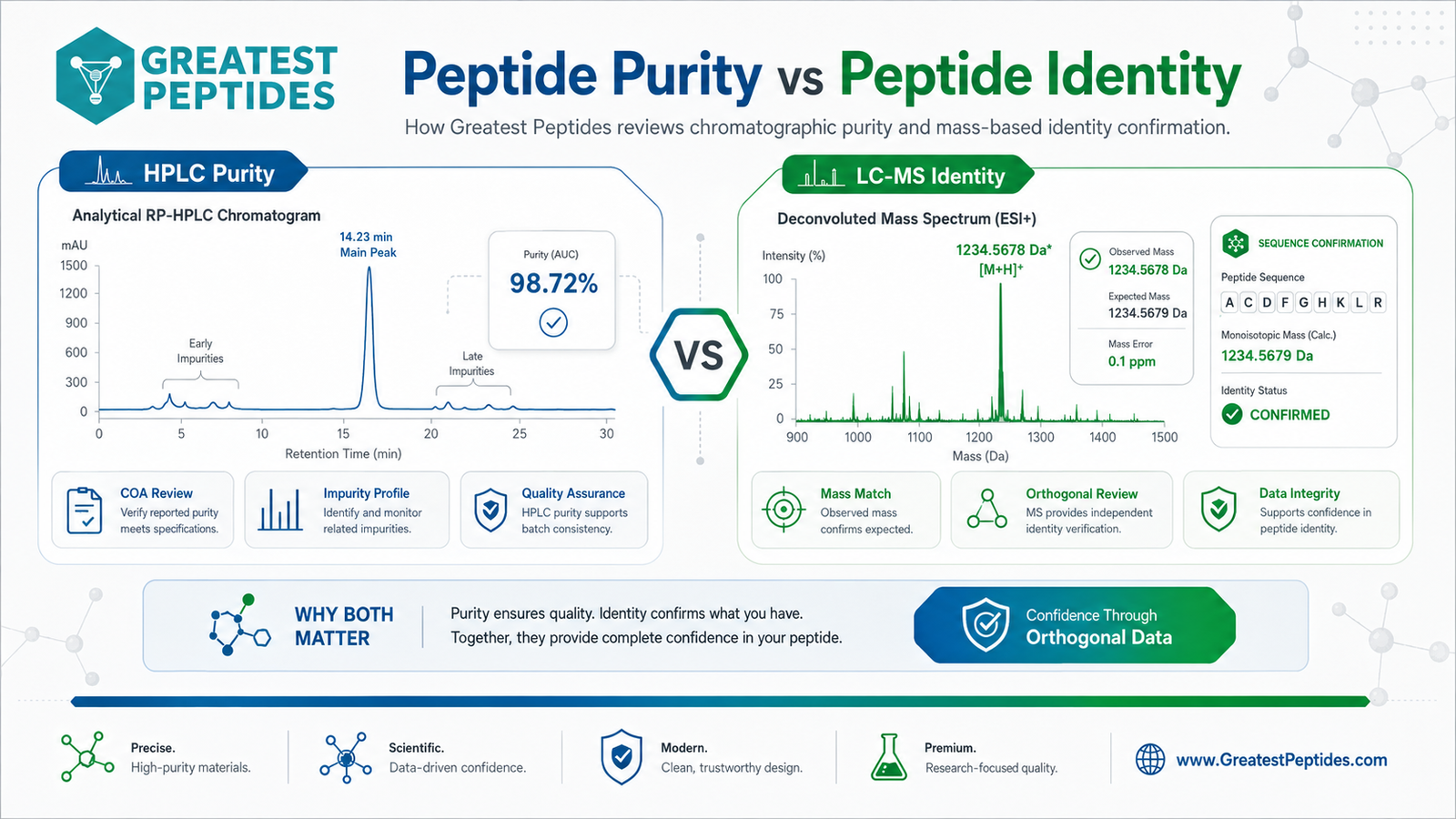
Peptide purity and peptide identity are related but separate analytical attributes. This guide explains how laboratories evaluate each one, why both belong on a serious COA review, and what research buyers should look for in RUO peptide documentation.
READ ARTICLE →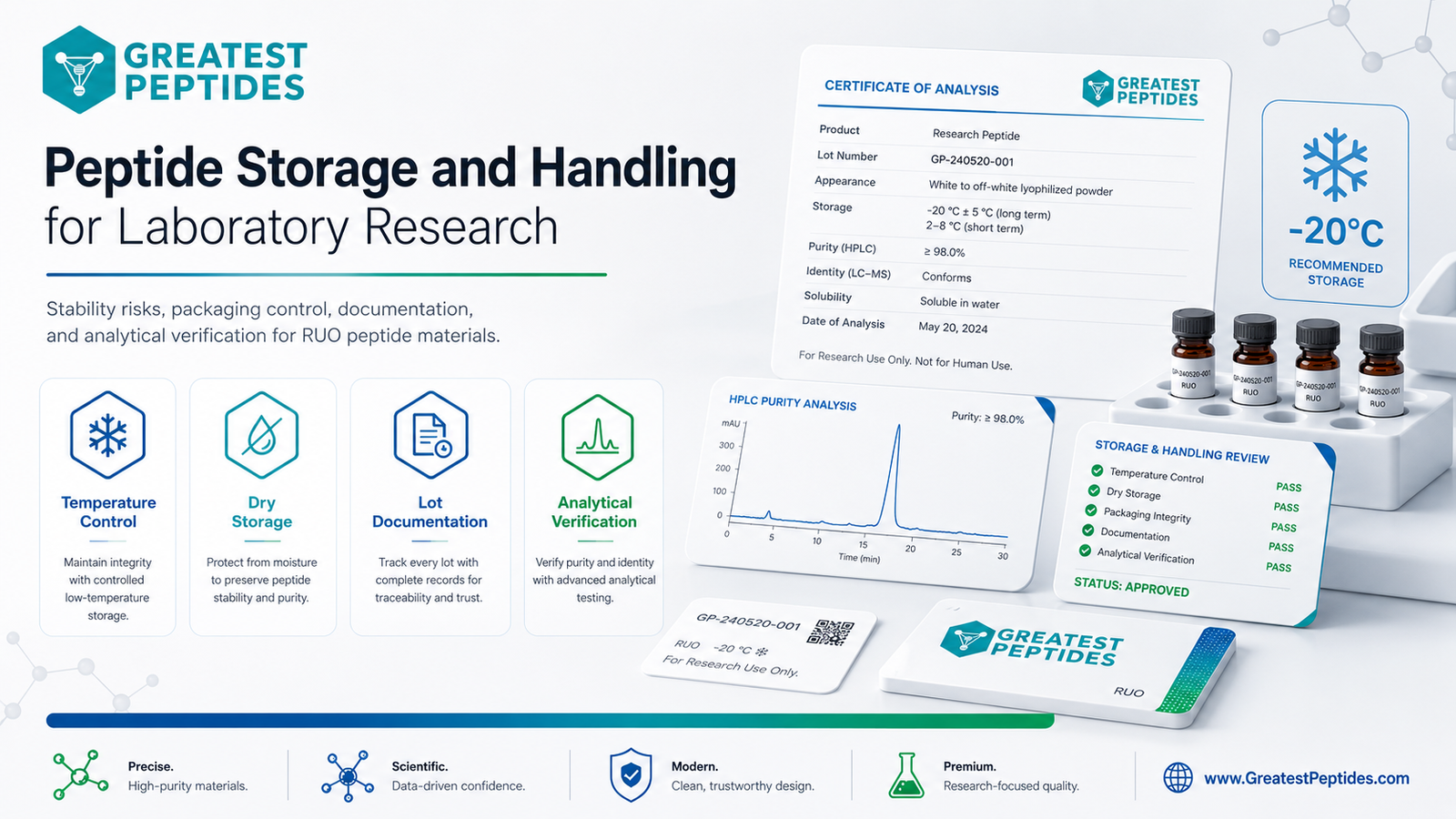
Stability risks, packaging control, documentation, and analytical verification for RUO peptide materials.
READ ARTICLE →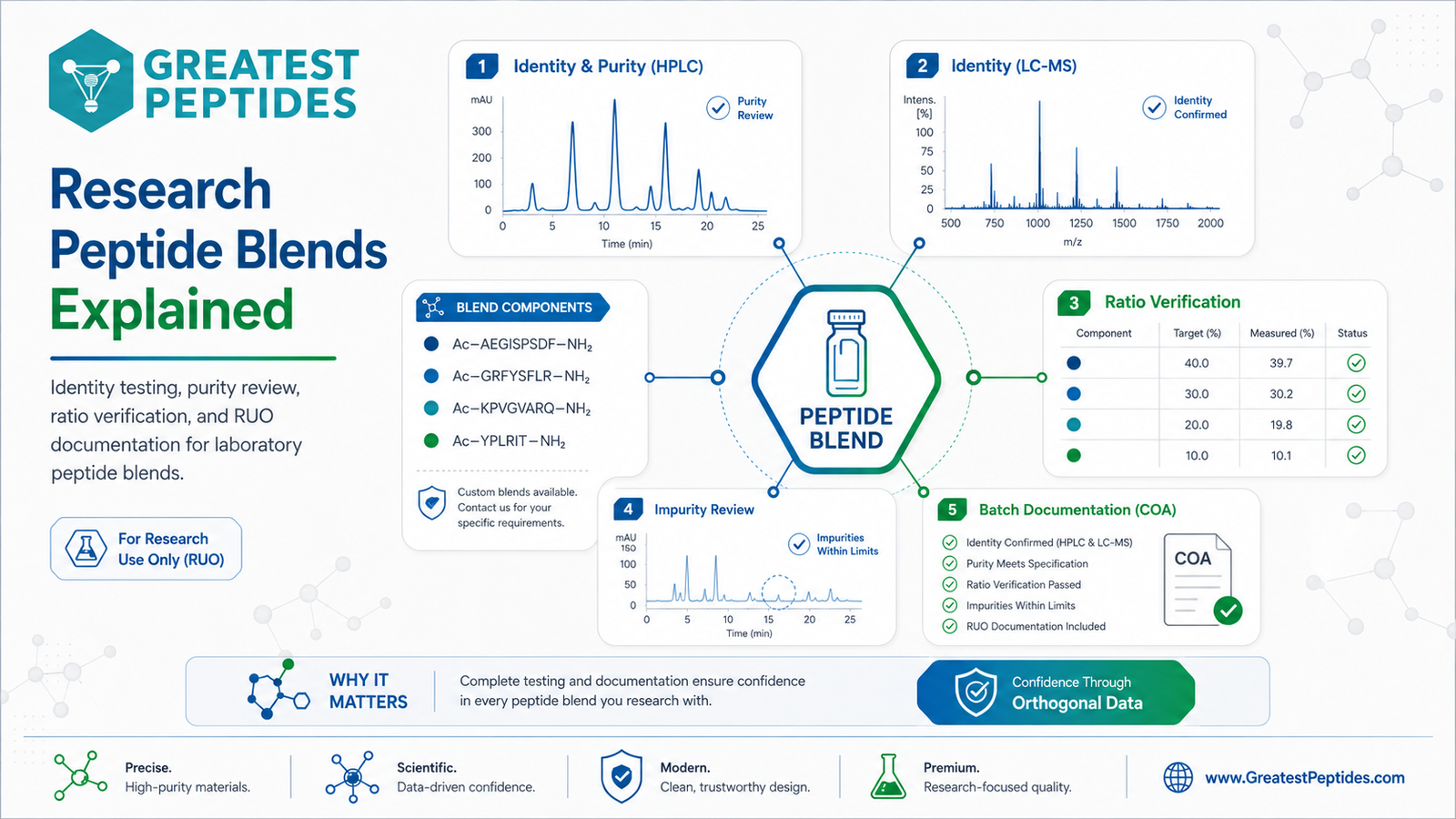
Identity testing, purity review, ratio verification, and COA documentation for laboratory peptide blends.
READ ARTICLE →
A RUO guide to stability data, aggregation, assay recovery, and COA review across freeze-thaw cycles.
READ ARTICLE →